23:32 BST
Sun 01 Nov 2026
Market: Closed

🇧🇩 Economic Heat Map · November 2026

নভেম্বর ২০২৬ — অর্থনীতির উত্তাপ

এই মাসে বাংলাদেশের অর্থনীতিকে যে আটটি বিষয় নাড়াচ্ছে — ওজন অনুযায়ী সাজানো

November 2026 Economic Heat Map · Compiled 1 November 2026

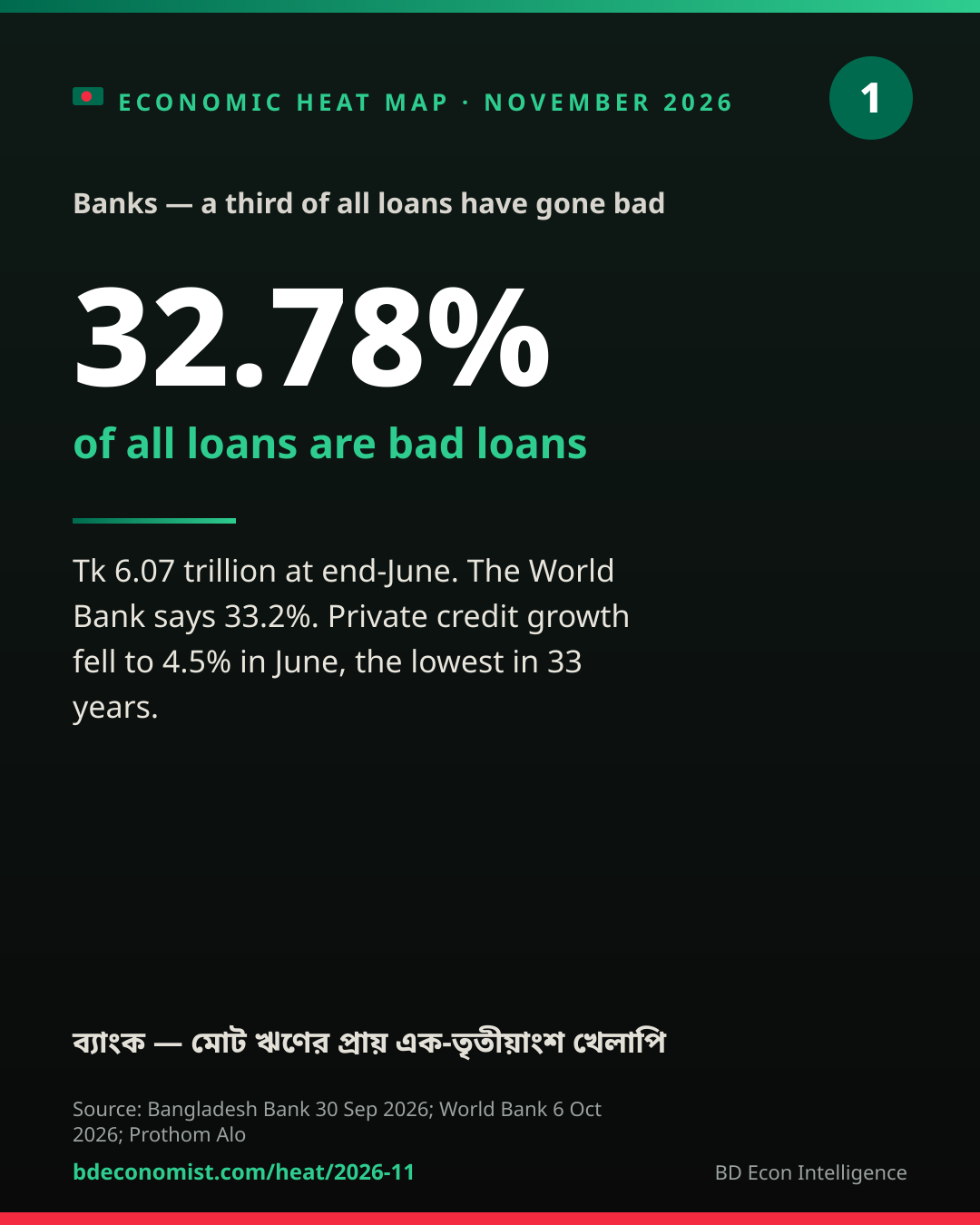
32.78%
Bad loans, share of all loans
Tk 43,000 crore
Revenue gap, July–September
24 Nov 2029
New LDC graduation date
3.4%
World Bank, FY27 growth
8.34%
Inflation, September
9.50%
Policy rate, held
Compiled 1 November 2026 · Editorial heat scan

The Heat Map

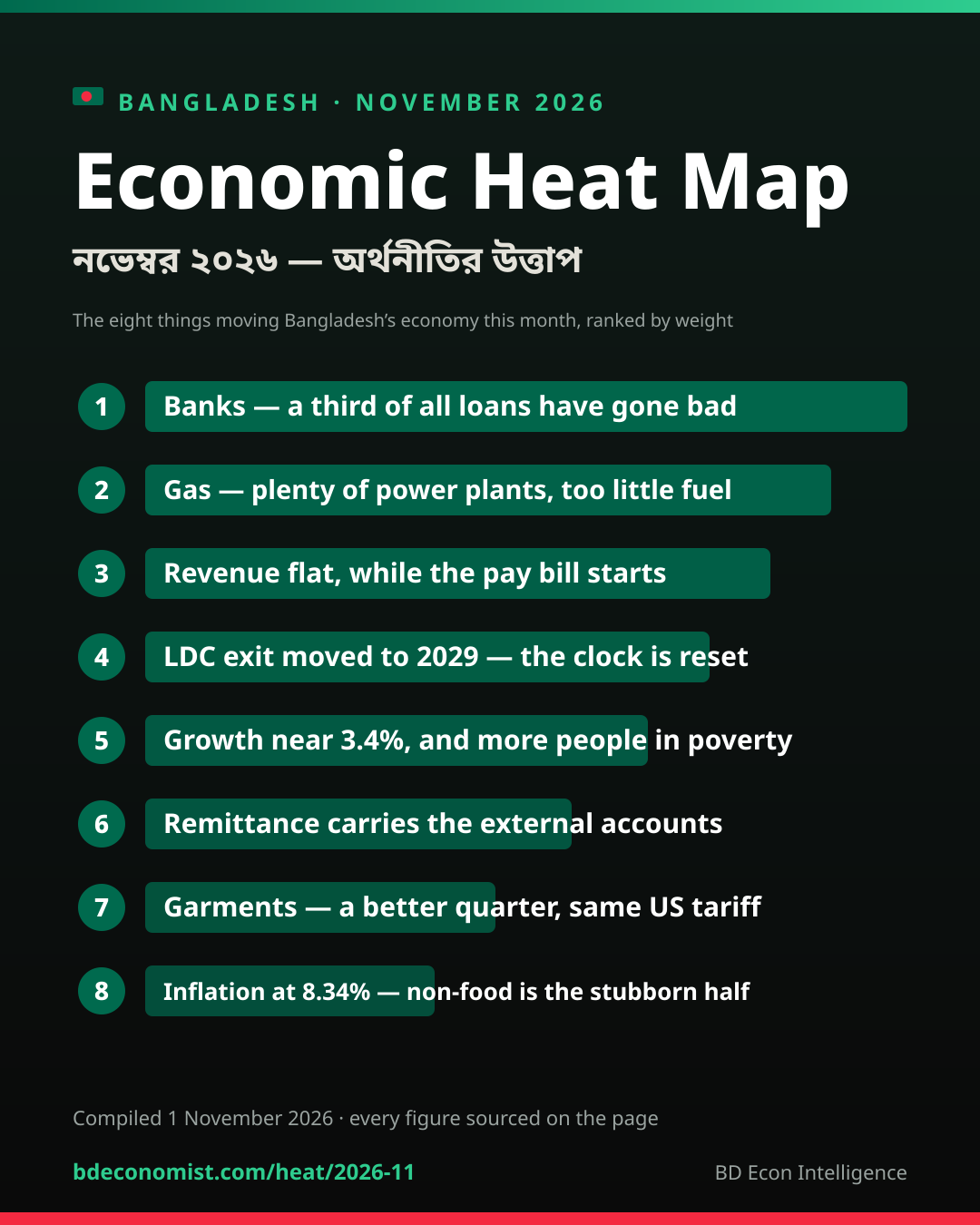
Eight stories, ranked by how much of the economy they move this month. Every figure below carries its source and date.

The Eight, Ranked

A figure marked "verified" was re-read at its source or matched against our data layer on that date. A figure marked "reported" is press-reported and not yet cross-checked.

1

The heaviest number this month

Banks — a third of all loans have gone bad

ব্যাংক — মোট ঋণের প্রায় এক-তৃতীয়াংশ খেলাপি

What happened

Bad loans were Tk 6.07 trillion at the end of June. Bangladesh Bank puts the ratio at 32.78%; the World Bank says 33.2%, up from 30.6% in December. Private credit growth fell to 4.5% in June, which the World Bank calls a 33-year low. On 30 October the government signed a $450 million World Bank credit for the financial sector.

Why it is the story

When this much lending is not coming back, lending slows. Bangladesh Bank says demand for credit is weak, that stronger banks hold plenty of cash while weaker ones still struggle for funds, and that firms are delaying expansion. Its own liquidity support is reported at Tk 760 billion.

The numbers

The BD Econ angle

The cost lands as slower credit: growth of 4.75% in August, with a weakened bank less able to lend to a factory trying to reopen. Quote 32.78% and 33.2% as a range and name who said which. Watch credit growth more closely than the next scandal.
2

The bill arrives in stages

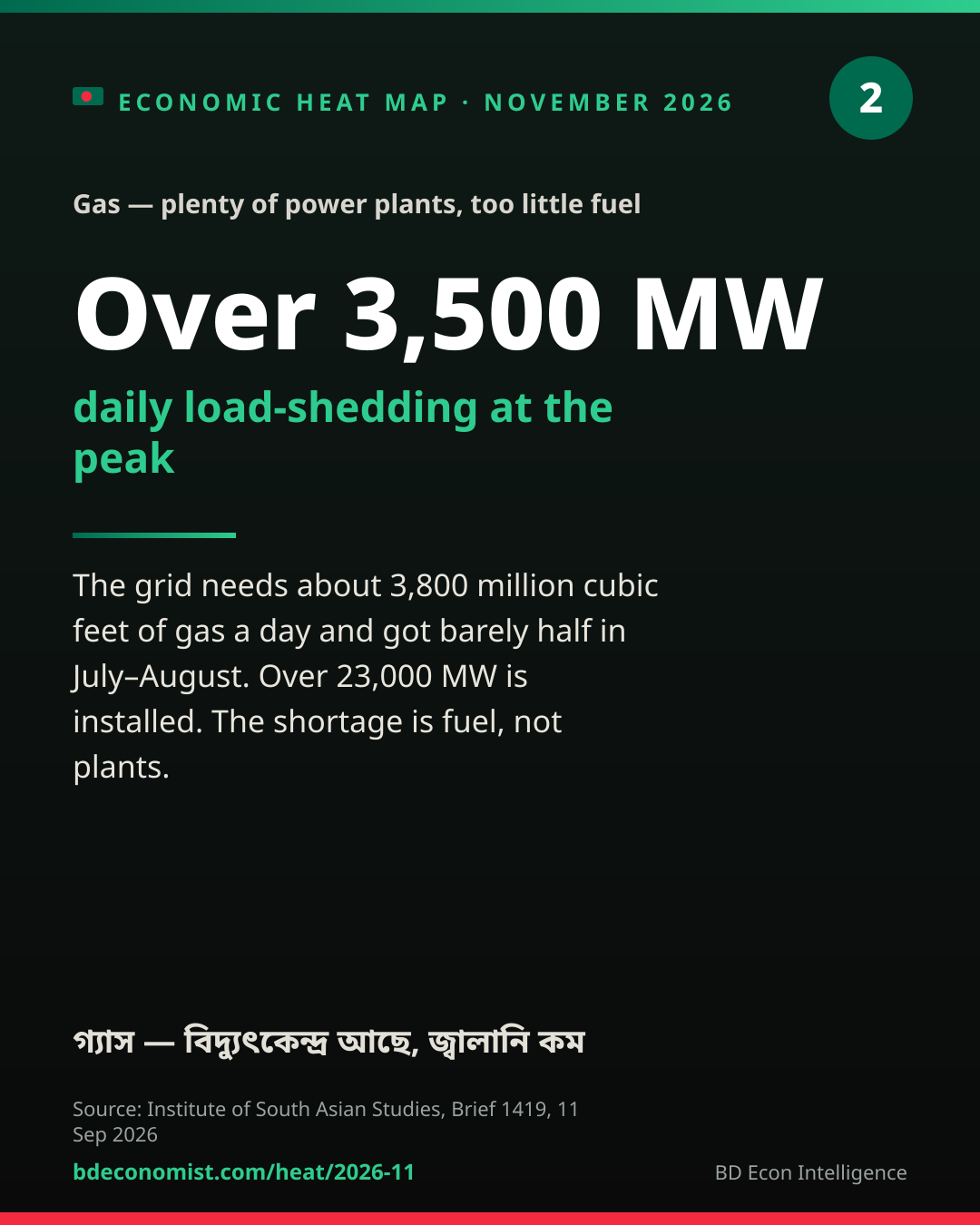
Gas — plenty of power plants, too little fuel

গ্যাস — বিদ্যুৎকেন্দ্র আছে, জ্বালানি কম

What happened

The grid needs about 3,800 million cubic feet of gas a day and got barely half during July and August, with load-shedding above 3,500 MW at the peak. Installed capacity is above 23,000 MW. All imported LNG comes through two floating terminals. QatarEnergy, which supplied close to 60% of it, declared force majeure.

Why it is the story

Gas runs power, industry and fertiliser at once. On 28 October Oilprice, citing a source at the state gas company quoted by Reuters, reported Qatar’s force majeure running to the end of the year, though separate Qatari cargoes had been awarded for November. The dearest spot price reported, on 15 September, was $29.795 per million British thermal units. The shock is projected to add $4.8 billion to the annual import bill.

The numbers

The BD Econ angle

A fuel bill is a price rise with a delay built in: first load-shedding, then short shifts at the factory, then a tariff notice, then non-food inflation. Count the chain, not the outage. Check the month before quoting the Qatar date: it has moved step by step.

3

Two lines, one chart

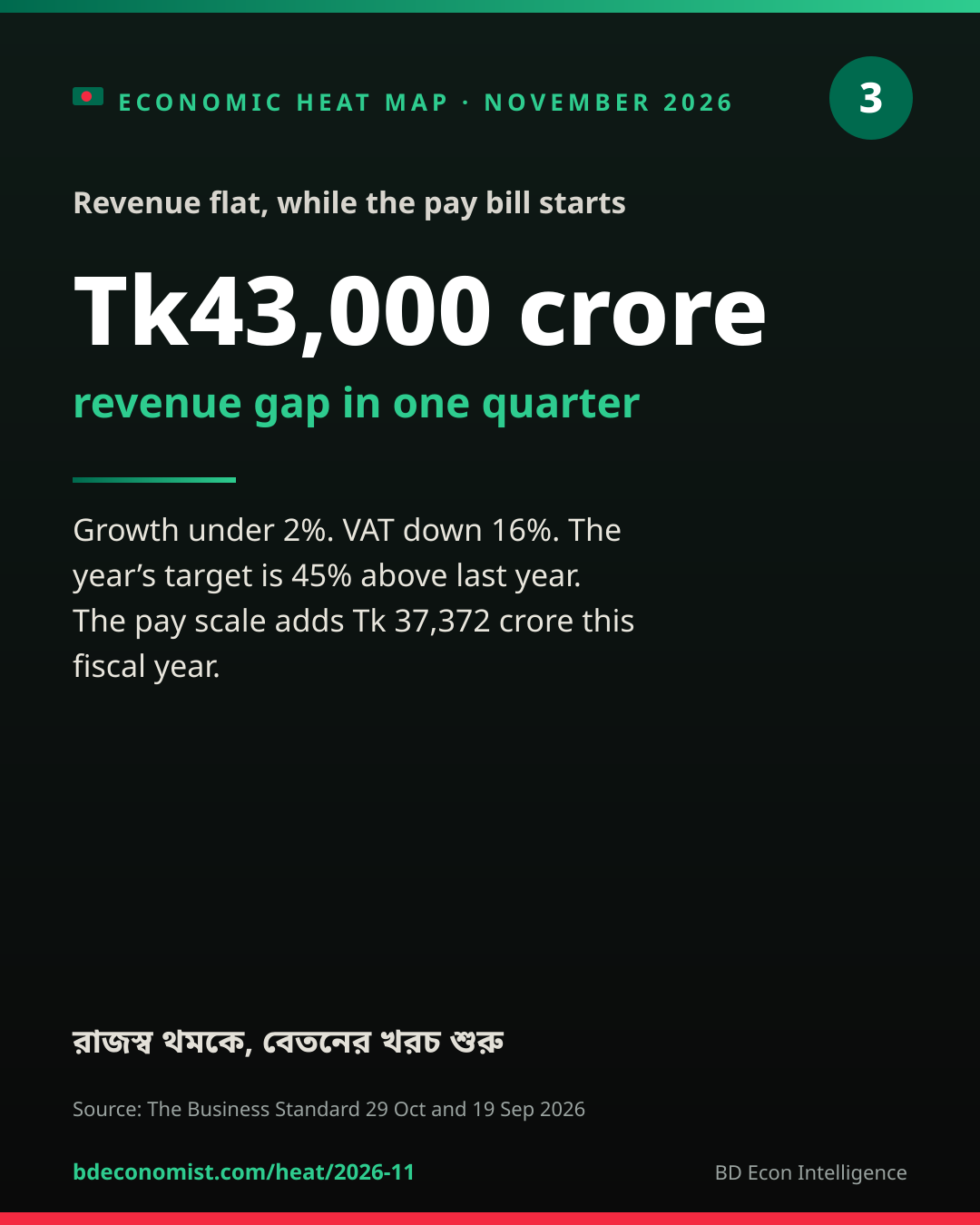
Revenue flat, while the pay bill starts

রাজস্ব থমকে, বেতনের খরচ শুরু

What happened

Revenue in July–September was slightly over Tk 92,000 crore against a Tk 1.35 lakh crore target, a gap of Tk 43,000 crore. Growth was under 2%. VAT fell 16%; income tax rose 16%. The new pay scale costs Tk 105,380 crore over three years, Tk 37,372 crore of it this fiscal year.

Why it is the story

The year’s target is Tk 6.04 lakh crore, 45% above last year’s collection. Revenue is 8.3% of GDP, among the lowest in the world, and the deficit widened to 3.9% of GDP. Development spending reached only 3.89% of plan in the quarter, reported as the lowest first quarter on record.

The numbers

The BD Econ angle

A 45% target against 2% growth is not a forecast, it is a gap. A tax official links part of the VAT fall to the move to quarterly returns; economist Zahid Hussain disputes that this fully explains the gap, noting that July–September payment deadlines had already passed. Read the pay-scale total as three years, not one.

4

A deadline with a new date

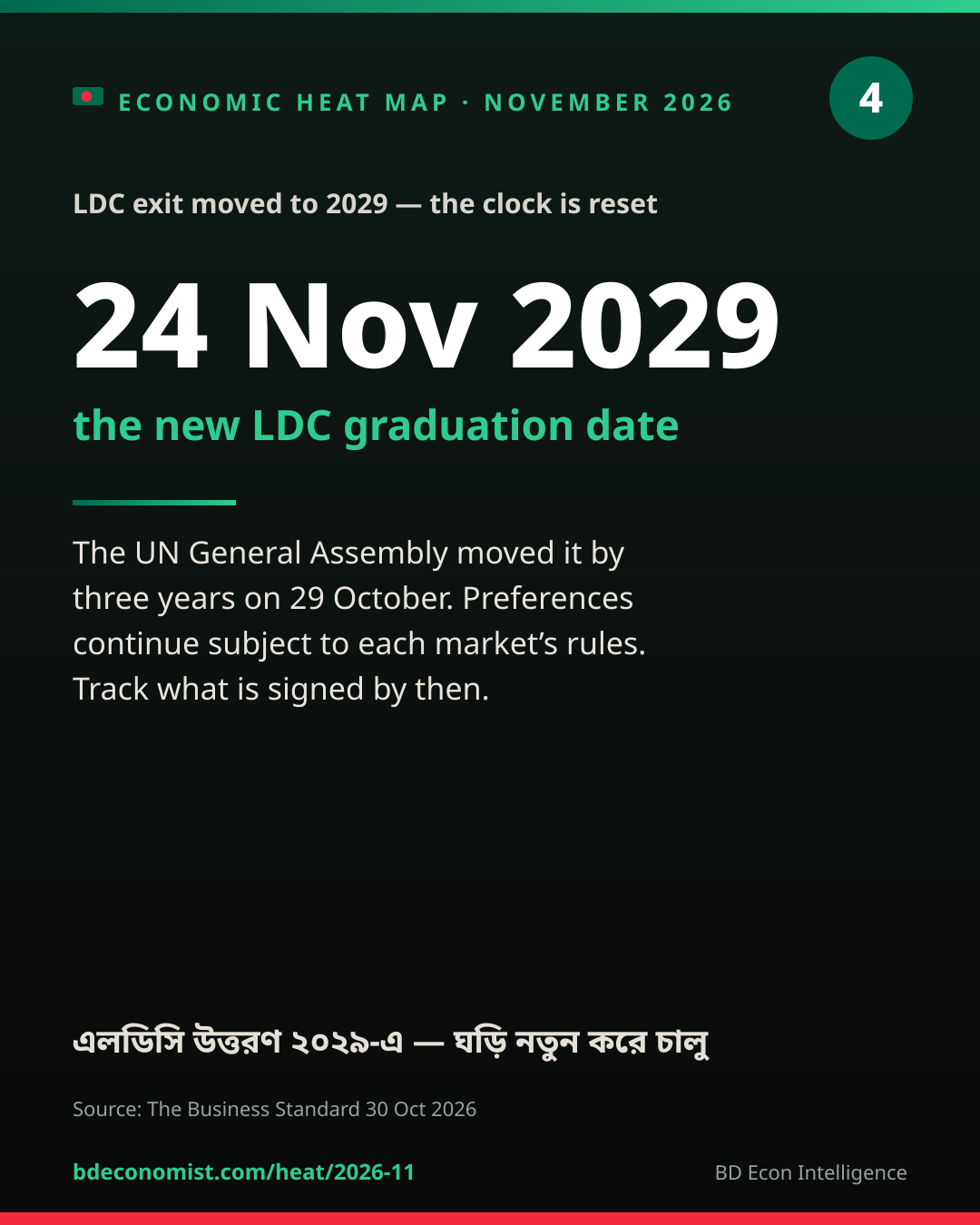
LDC exit moved to 2029 — the clock is reset

এলডিসি উত্তরণ ২০২৯-এ — ঘড়ি নতুন করে চালু

What happened

On 29 October the UN General Assembly gave Bangladesh and Nepal three more years, moving graduation from 24 November 2026 to 24 November 2029. The UN’s development committee had backed an extension; reports differ on whether it favoured the full three years, which the Assembly granted.

Why it is the story

Preferences continue subject to each market’s rules, and those rules are moving. New EU rules apply from 1 January 2027. UNCTAD, as reported by Australian Outlook, projects a 32% fall in total exports, over $17.5 billion, on graduation. Exporters and economists alike say the time has to be used.

The numbers

The BD Econ angle

Three years is a deadline, not a reprieve. Track what gets signed and ratified by November 2029: the Japan agreement of 6 February, the RCEP working group agreed on 21 September, and the EU route. Write the countdown, not the relief.

5

Read it next to the poverty count

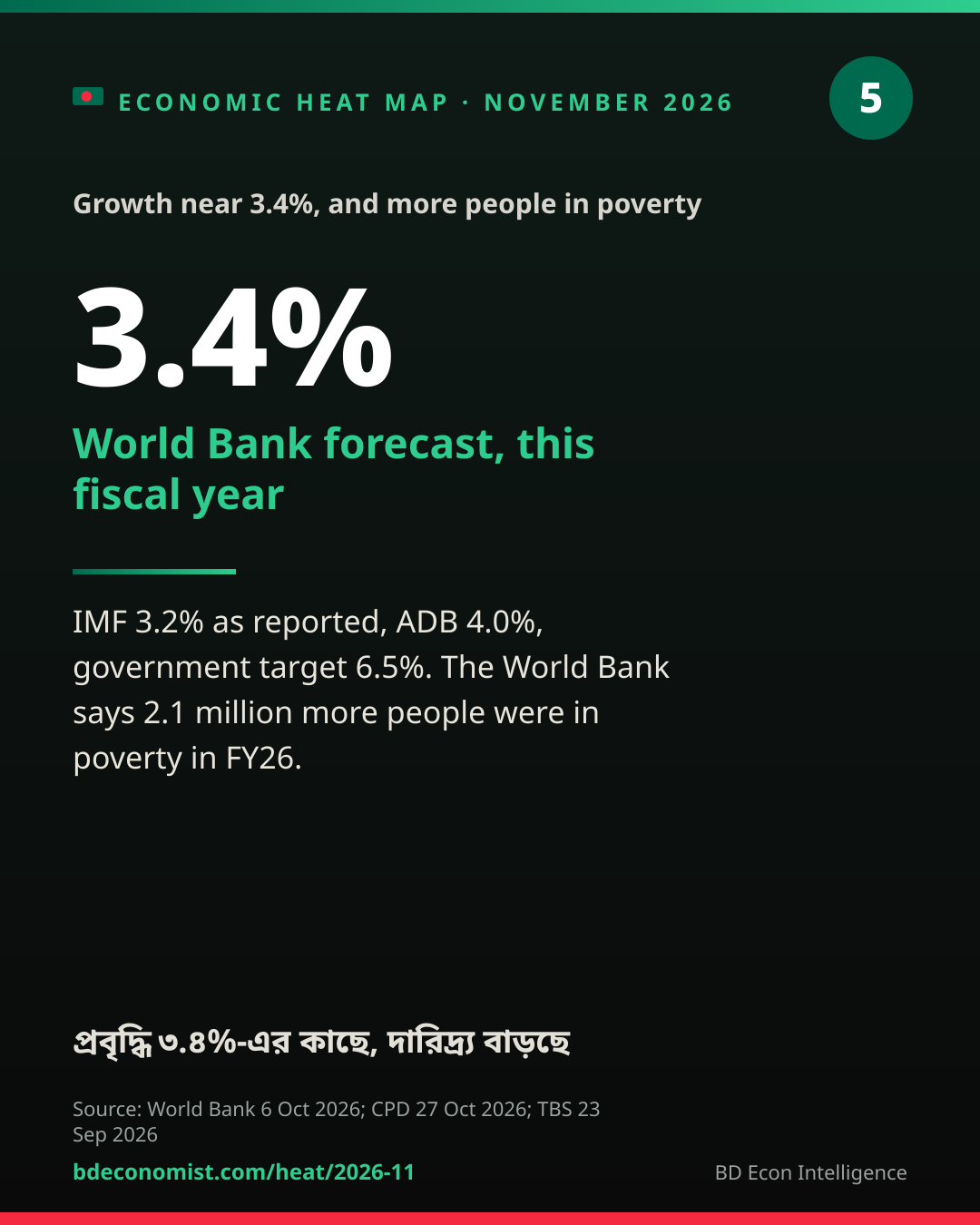
Growth near 3.4%, and more people in poverty

প্রবৃদ্ধি ৩.৪%-এর কাছে, দারিদ্র্য বাড়ছে

What happened

For FY27 (July 2026 – June 2027) the World Bank says 3.4%, the IMF is reported at 3.2%, the ADB says 4.0%, and the government’s target is 6.5%. The World Bank also says 2.1 million more people were in poverty in FY26. It sees 3.9% in FY28.

Why it is the story

The statistics bureau’s annual estimate for FY26 was 4.14% in June; its quarterly figures, reported in October, put the year at 3.68%. Growth fell to 2.22% in the third quarter, with industry down 0.28%, then rose to 4.60% in the fourth. Female labour force participation fell from 42.8% to 38.4% between 2022 and 2024. A Tk 60,000 crore stimulus announced in May is meant to help.

The numbers

The BD Econ angle

The stimulus includes Tk 20,000 crore to reopen closed factories, and the central bank itself warns that delays, weak banks and borrower debt could limit it. Ask how much has gone out, not how much was announced. October’s page quoted the World Bank at 4.6% and the IMF at 3.5%: both have since fallen.

6

Strength and exposure in one number

Remittance carries the external accounts

বৈদেশিক হিসাবের ভরসা রেমিট্যান্স

What happened

Remittance in October was $2.87 billion, up 12.1%, the fifth month in a row under $3 billion. July–October was $11.465 billion, up 13%. September alone had risen only 2.2%. Reserves on 26 October were $36,411.83 million gross and $31,600.40 million on the IMF’s basis.

Why it is the story

FY26 closed at a record $35.56 billion, and the central bank calls remittance the main external buffer. The balance of payments ended FY26 with a $6.60 billion surplus, then moved into deficit in the first two months of FY27 as foreign investment stayed weak and debt payments rose.

The numbers

The BD Econ angle

Two reserve numbers, one date, about $4.8 billion apart: always say which one. And watch the pace of remittance, not the level: industry sources quoted by The Daily Star blame the Middle East war for the months under $3 billion. One household transfer at a time is propping up the accounts.

7

The story moves to demand

Garments — a better quarter, same US tariff

পোশাক — ভালো প্রান্তিক, মার্কিন শুল্ক একই

What happened

Garment exports in July–September were $10.58 billion, up 6.10%. The EU took $4.90 billion and 46.36%; the US $2.22 billion and 20.99%, up 10.40%. Total merchandise exports were $13.094 billion, up 6.34%. The total US duty on Bangladeshi garments stays at 25.62%.

Why it is the story

Garments earned $38,701.15 million of the $48,001.91 million exported in FY26. The tariff stopped moving when the 10% measure of 24 July replaced an expiring one, so the question is now demand. The central bank still reports subdued world demand for garments.

The numbers

The BD Econ angle

One 6% quarter is not a recovery until two more say so. The US grew fastest, at 10.40% against the EU’s 3.33%, and brought about a third of the quarter’s gain.

8

Name which half is in your bill

Inflation at 8.34% — non-food is the stubborn half

মূল্যস্ফীতি ৮.৩৪% — খাদ্যবহির্ভূত ভাগই একগুঁয়ে

What happened

Inflation rose to 8.34% in September from 8.26% in August, against 8.36% a year earlier. Food rose to 7.22% from 7.02%. Non-food eased to 9.30% from 9.32%. Bangladesh Bank’s policy rate is 9.50%, held at its committee meeting of 23 September, and its statement is now quarterly.

Why it is the story

The government’s target is 7.5%. The ADB expects 9% this year and the World Bank 8.6%. The central bank names the risks itself: world energy prices, the Strait of Hormuz, the late-September fuel price rise and the pay scale. The US Federal Reserve also raised rates in September.

The numbers

The BD Econ angle

Non-food is what the bank calls stubbornly high: fuel, rent and transport do not take a good harvest. October’s figure, due in early November, is the first full month after the fuel rise.

On the Desk — Not Yet a Piece

  • ▪October inflation, due in the first week of November — the first full month after the fuel rise
  • ▪October export total — not yet published
  • ▪The new IMF programme: reported at $4.5 billion to $5 billion, not agreed
  • ▪Whether Qatar’s LNG returns in the new year, as one reported source implies
  • ▪How much of the Tk 60,000 crore stimulus has actually gone out

Watch-list items are unranked and may drop out next month.

Share the Heat Map

Six cards built for WhatsApp & social — tap to download, forward freely.

November 2026 Economic Heat Map

Bangladesh Bank · World Bank · Asian Development Bank · Centre for Policy Dialogue · Institute of South Asian Studies · The Business Standard · The Financial Express · Prothom Alo · The Daily Star · UNB · Oilprice.com · Asia News Network · Australian Outlook · Value Chain Asia

EDITORIAL — ranked by economic weight on 1 November 2026. Figures come from the publishing institution or the press, each with its source and date; this page does not update live.

Every month’s heat map →

Looking for June's budget analysis? Budget 2026-27 →